My ‘Best of’ list usually combines both my favorite fiction and non-fiction books of the year. However, I read so many great books this year that I’m going to have separate posts for fiction and non-fiction. My list of favorite fiction picks from 2025 can be found here.
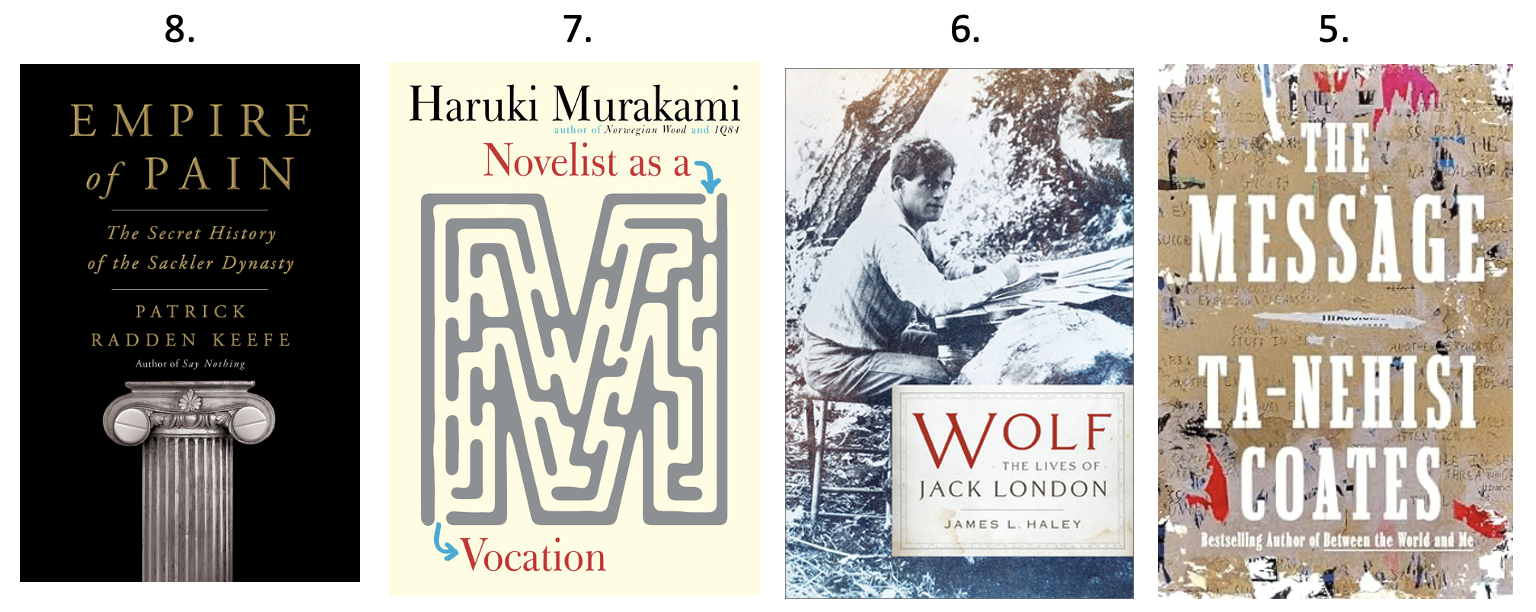
- Empire of Pain: The Secret History of the Sackler Dynasty (2021), by Patrick Radden Keefe
A very easy 5 stars. Keefe does an amazing job of combining great writing with thorough research. It would be incredibly easy for this book to get bogged down in facts and feel like a textbook but instead this competes with the best fiction for how compelling it is.
On a side note, one of the things I love about history is that it may sometimes take a while but it eventually settles every score. Arthur Sackler was celebrated in his own lifetime even though he created the conditions for the opioid crisis and fostered a family of psychopaths. Fast forward a couple decades, to his family name being so reviled no one wants to be associated with it. That’s a nice thing to see.
Another interesting thing is the difference between how an incredibly rich family, responsible for hundreds of thousands of deaths, is treated by the legal system and the press, compared to some kid who kills one CEO in cold blood. If there was actual justice, the Sacklers would be treated exactly the same way as murderers, but instead they pay what amounts to a fine.
- Novelist as a Vocation (2015), by Haruki Murakami
I love everything Murakami writes, and this was no different. This had a nice combination of the author’s personal experiences as a writer, his views on making it as an author, his overall impression of the industry and critics, etc. Throughout, Murakami provides the same kind of straightforward and earnest style that makes his fiction so readable.
- Wolf: The Lives of Jack London (2010), by James L. Haley
I had zero expectations going into this, but it turned out to be one of the best biographies I’ve ever read. I love a biographer who starts by stressing that different historical accounts contradict one another and then establishes an approach of discussing each varying account of a story, event, relationship, etc and then assessing which is most likely true while giving credence to each. That’s what Andrew Roberts does in Napoleon: A Life and it’s part of what made that book such an incredible biography, and it’s the opposite of what David McCullough did in Truman, in which he couldn’t remain objective at all and, as a result, created a biography void of any value.
As for London himself, all I knew was that he wrote a couple Alaska adventures and The Iron Heel, which is one of the best dystopians of all time. It turns out his life was pretty extraordinary:
– In his youth, he was an oyster pirate
– He spent part of his life as a hobo
– He’s credited with writing the article about surfing that brought attention to it outside of Hawaii and made the sport boom in popularity
– He was one of the top war correspondents of the day
– At his peak, he was the most popular writer in America
– He died at the age of 40
– The FBI created a case file about him after his death due to how outspoken he’d been about socialism.
- The Message (2024), by Ta-Nehisi Coates
Coates has entered that territory for me where I’ll read anything and everything he writes. For my money, he and Chris Hedges are by far the two best commentators on social and political issues. This was an incredibly powerful and timely book. Highest possible recommendation, especially if you care at all about racism in the 21st century or just enjoy nonfiction at all.
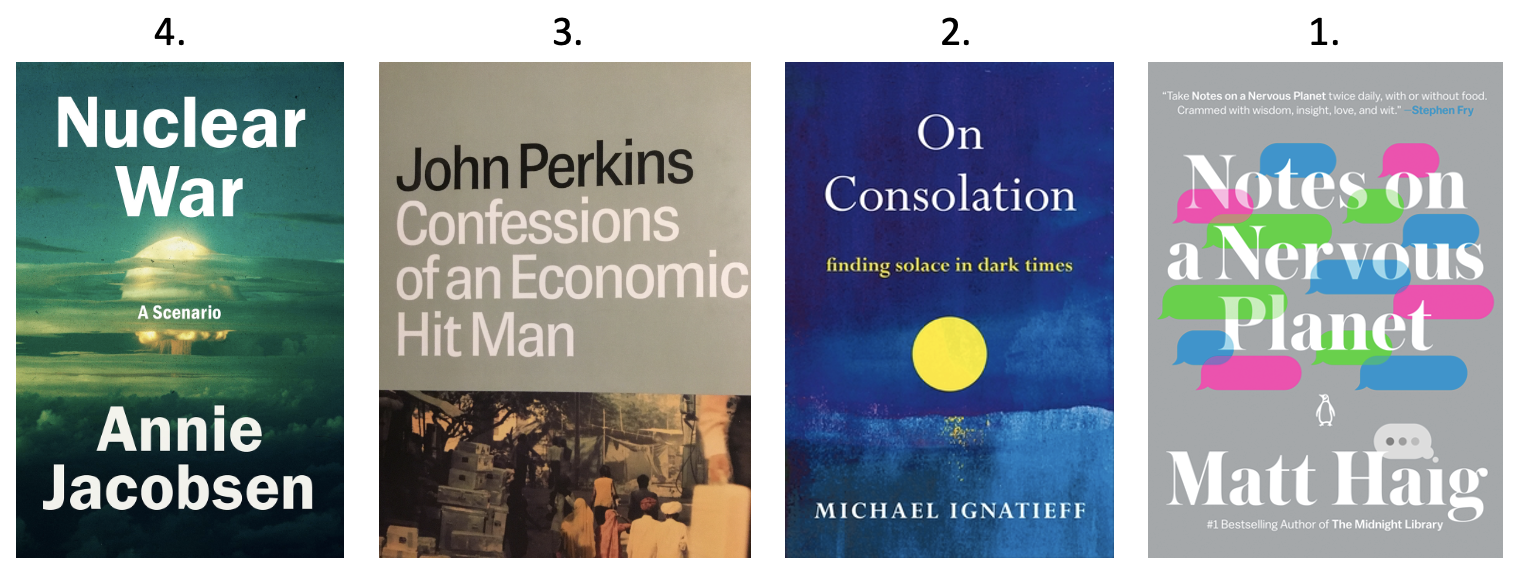
- Nuclear War: A Scenario (2024), by Annie Jacobsen
If you’ve ever wondered what an actual nuclear war would be like, this nonfiction scenario will let you know exactly how apocalyptic it will be. This will definitely be the most disturbing non-fiction I’ll read all year. As with her other books, Jacobsen does a great job of keeping the reader engaged and being utterly compelling throughout. Almost all of this book is dedicated to the first 60 minutes of the missiles flying. Only the last 20 pages deal with the actual aftermath, but that’s enough, as it is truly horrific. Highly recommended for anyone who loves nonfiction or true life apocalyptic fiction.
- Confessions of an Economic Hit Man (2005), by John Perkins
One of the dumbest lies our politicians ever say and our media gives credence to is that terrorists hate us because they hate our freedoms. Anyone who says that is begging not to be taken seriously. Terrorists hate us because the U.S. has overthrown their governments, thrown entire regions into turmoil, intentionally destroyed other countries economies, and plundered their natural resources.
This book does an excellent job of showing how the IMF and World Bank are used to entrap developing countries into a cycle of debt that drives millions into poverty while U.S. corporations take all of their natural resources. And when that fails the CIA’s ‘jackals’ either enable a government overthrow or assassinate the country’s leader. And if that fails our military goes in and destroys everything.
It’s happened so many times over the decades that much of the rest of the world despises what the U.S. stands for. This is one of those books that isn’t fun to read but is totally necessary for understanding current geopolitics and why much of the world is getting behind China rather than the U.S.
- On Consolation: Finding Solace in Dark Times (2021), by Michael Ignatieff
This sounds like a self-help book and while part of it is, that’s really the third-most relevant aspect of it.
– First and foremost, it’s a series of very precise biographies of famous historical figures and how each dealt with grief in their own way.
– Second, it’s a history book on the evolution on the concept of grief and the resulting consolation.
– And third, through these two aspects, Ignatieff does a great job of bringing everything back to how the reader may benefit from each of these historical stories.
I loved every part of this. I had never heard of Ignatieff and know nothing about him but after reading this I will gladly read whatever else I find by him.
- Notes on a Nervous Planet (2018), by Matt Haig
Haig is best known for The Midnight Library and other deeply speculative fiction, and while I’ve enjoyed both of Haig’s novels that I’ve read so far it is this book of nonfiction that delivers the most impact and is his best work.
I read a lot of nonfiction on how to live a better life, be happier, be healthier, etc. and this is one of the very best I’ve come across. Haig does a great job of talking about depression and anxiety in a way that is genuinely comforting and reassuring.