My ‘Best of’ list usually combines both my favorite fiction and non-fiction books of the year. However, I read so many great books this year that I have separate posts for them. My list of favorite non-fiction picks from 2025 can be found here.
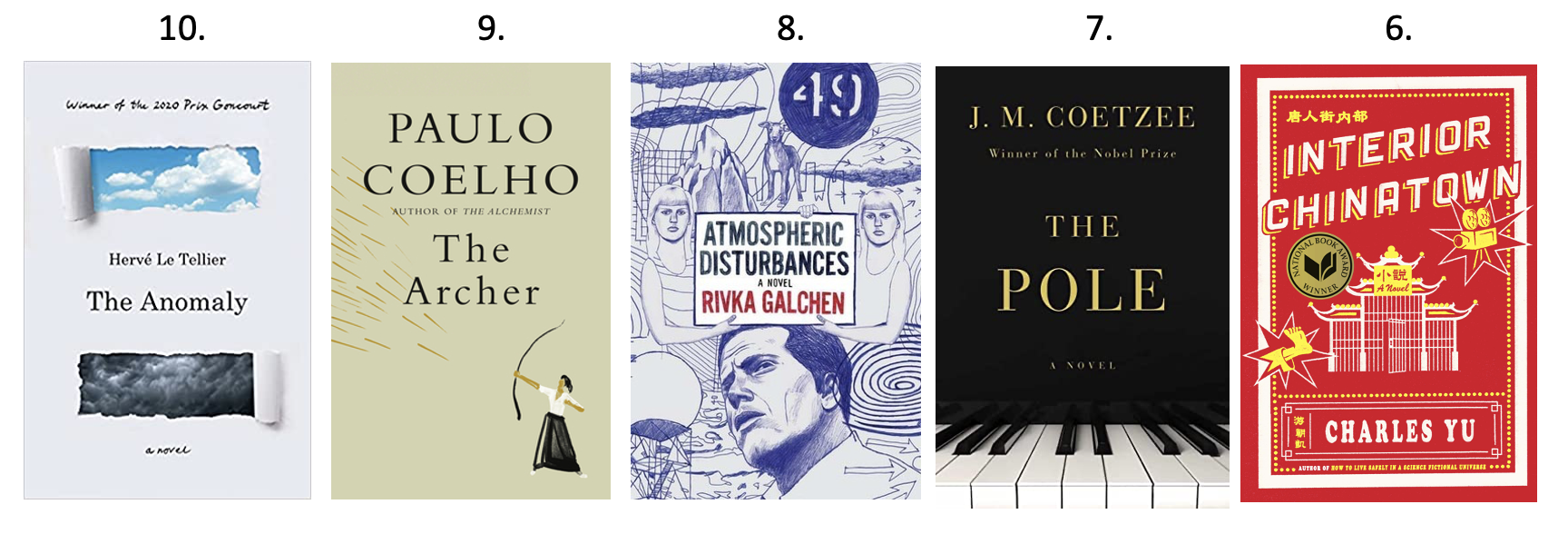
- The Anomaly (2020), by Hervé Le Tellier
The premise is extremely sci-fi but the execution is speculative and literary, which I enjoyed. Instead of thrills and action there are the logistical considerations of what would actually happen if there were two versions of the same people. While I love action-packed, adventure sci-fi (Ready Player One) and sci-fi thrillers (Dark Matter), Le Tellier’s execution here is perfect for the type of story he is telling, as he recounts how the people, their families, and the government all try to come to terms with the reality of 200 doppelgangers actually existing.
Note: I originally had this as a 4-star book until I read an excellent critique of the ending that another reader left that explains the ending and its significance, and after reading it I absolutely love the ending as well and bumped this up to 5 stars.
- The Archer (2003), by Paulo Coelho
Typical Paulo Coelho, which is to say it’s inspiring, insightful, and easy to read. The allegory of the Archer works perfectly for Coelho talking about the importance of following your dreams and living a focused life. Each page is only a paragraph, so this is actually closer to a 50-page book at best, but it’s still very much worth reading.
Highly recommended to anyone who has read and enjoyed any of Coelho’s other books.
- The Pole (2023), by J.M. Coetzee
Another great book by Coetzee, with simple writing and storytelling and yet it manages to convey complex psychological ideas. In this book, Coetzee explores what it means to love and be passionate and the extreme disconnect between an artist’s love language and a purely analytical perspective.
This isn’t anywhere near Coetzee’s best and yet it’s still wonderful and leaves you thinking about it long after you’ve finished reading it.
- Atmospheric Disturbances (2008), by Rivka Galchen
There are a ton of books in the “Unreliable narrator” and “disassociated protagonist” categories but I think this may be the best I’ve ever read. Galchen does an amazing job of following the always-conspiratorial and irrational mindset of someone clearly going through a mental breakdown, in a way that never becomes tedious or unrealistic. In many novels like this I find myself groaning at a decision a character will make because it seems forced in order to keep the plot moving, but every single thing Galchen does here feels authentic. I enjoyed Galchen’s other novel, Everyone Knows Your Mother Is a Witch but found it to be almost entirely character focused, without a lot of plot. Here, though, Galchen blends great character development into an established plot, and the result is incredibly satisfying.
Highest recommendation for anyone who likes stories with unreliable narrators.
- Interior Chinatown (2020), by Charles Yu
I don’t like reading screenplays and was very skeptical of a book that would try to use that format. But instead of a cheap gimmick what ensued was an absolutely engrossing and powerful story that worked on every level. I loved that Wu’s story is told as if both his own life and that of the roles he plays are both real.
This was the first book I’ve read by Yu but after this I will 100% read anything else I find by him.
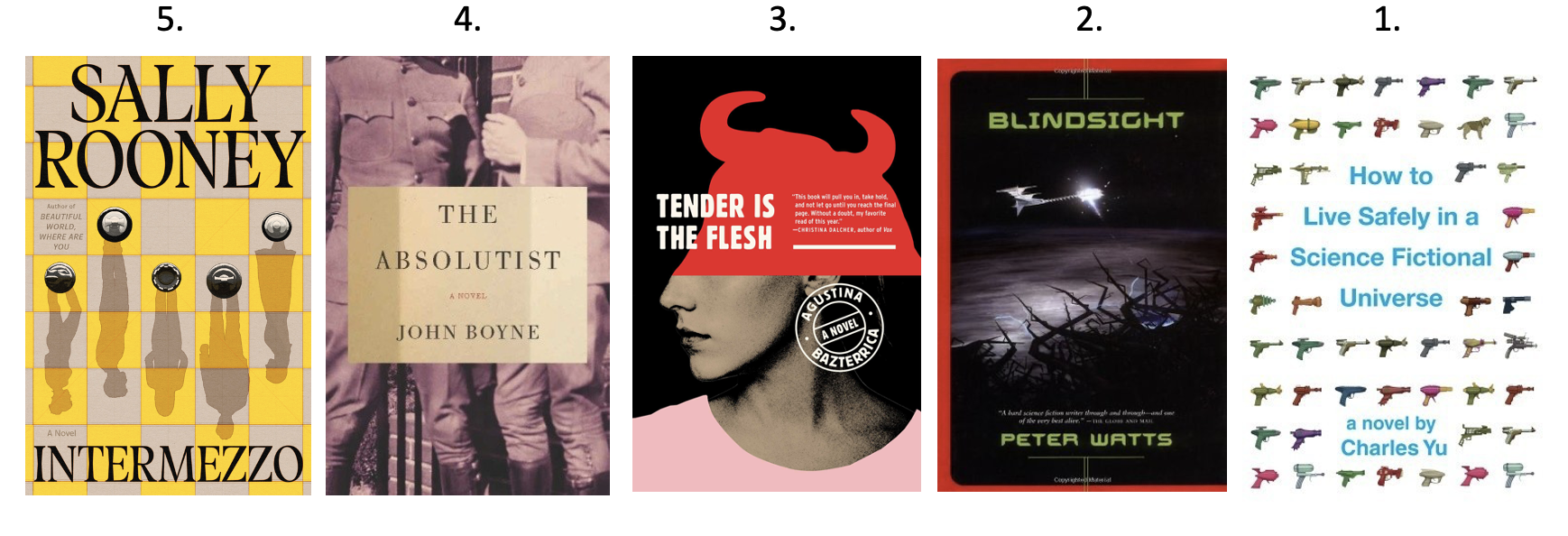
- Intermezzo (2024), by Sally Rooney
Another amazing story by Rooney. This book did two things for me:
1) Put her on my list of top five favorite living authors, and
2) Ensures I will read anything and everything she ever writes.
Good writers make you feel like their fictional characters are just the author writing about themselves. Rooney is such a great writer that two female characters with contrasting personalities both feel like they could be Rooney, and two male characters, polar opposites of each other, could also be her. She is that good at sounding authentic and creating characters who feel like living and breathing people.
Highest recommendation if you like literary fiction or contemporary fiction at all.
- The Absolutist (2011), by John Boyne
Prior to reading this, I knew nothing about this book or about Boyne as a writer. The first couple pages started off rough and disjointed for me but what followed was a beautiful and sad story with powerful dialogue, characters that were extremely realistic and human, and a plot that always felt authentic. After reading this, I will gladly read anything else I find by Boyne.
Highly recommended if you enjoy literary fiction.
- Tender Is the Flesh (2017), by Agustina Bazterrica
“Every plate contains death.”
Holy cow, this book is a lot of things:
– A brutal assessment of mankind’s relationship with animals and particularly with eating animals
– One of the most powerful dystopians I’ve read
– The most disturbing book of any genre I’ve ever read
If you like dystopians and as long as you’re okay with extremely unpleasant material, highest possible recommendation.
- Blindsight (2006), by Peter Watts
This is the epitome of great science fiction. I knew nothing about it or the author going into it, and I much prefer grounded, Earth-based sci-fi rather than outer space alien sci-fi found here, but every part of this worked for me.
This reminded me of Michael Crichton’s Sphere combined with Joe Haldeman’s The Forever War, both of which I thought were terrific. Some of the great things about this book:
– You are never quite sure until the very end what type of story this will be (i.e., devious ship’s captain, unreliable narrator, some kind of alien test, an all-out alien war, etc.)
– Many sci-fi authors have an area of expertise they specialize in (for Michael Crichton, it was medicine and biology). Here, Watts is so brilliant that he sounds like a genuine expert in biology, chemistry, space travel, astro physics, psychology, advanced mathematics, and more, and he never comes off as trying to sound smart. He just naturally inserts all of this into the book in a fluid way that creates an incredible reading experience.
– There are a couple devices used in the book (a ship’s captain who is a vampire, another crew member who counts as four different characters because of an intentional character modification) that if you explained them to me I would cringe and think they sounded silly, and yet Watts makes all of it not only work but thrive in a way that furthers the story.
Highest possible recommendation for anyone who likes smart sci-fi.
- How to Live Safely in a Science Fictional Universe (2010), by Charles Yu
I’m stingy with 5-star ratings and yet both books I’ve read by Yu have been easy 5-stars for me. I will now be adding everything I can find of his to my to-read list.
As for this book, the use of the time travel box as a metaphor for regret and ‘living in the past’ was utterly brilliant in how it was executed. There were a lot of times in this book where I felt like Yu was perilously close to going too far into the technical jargon and highly theoretical sciences, but each time he pulled me back in with the melancholy of the protagonist’s search for his father and the devices used to continue that search. In the end, just as with his Interior Chinatown, the result was a reading experience that is everything that’s great about books and storytelling.
Highest recommendation if you like very human yet very abstract science fiction.